
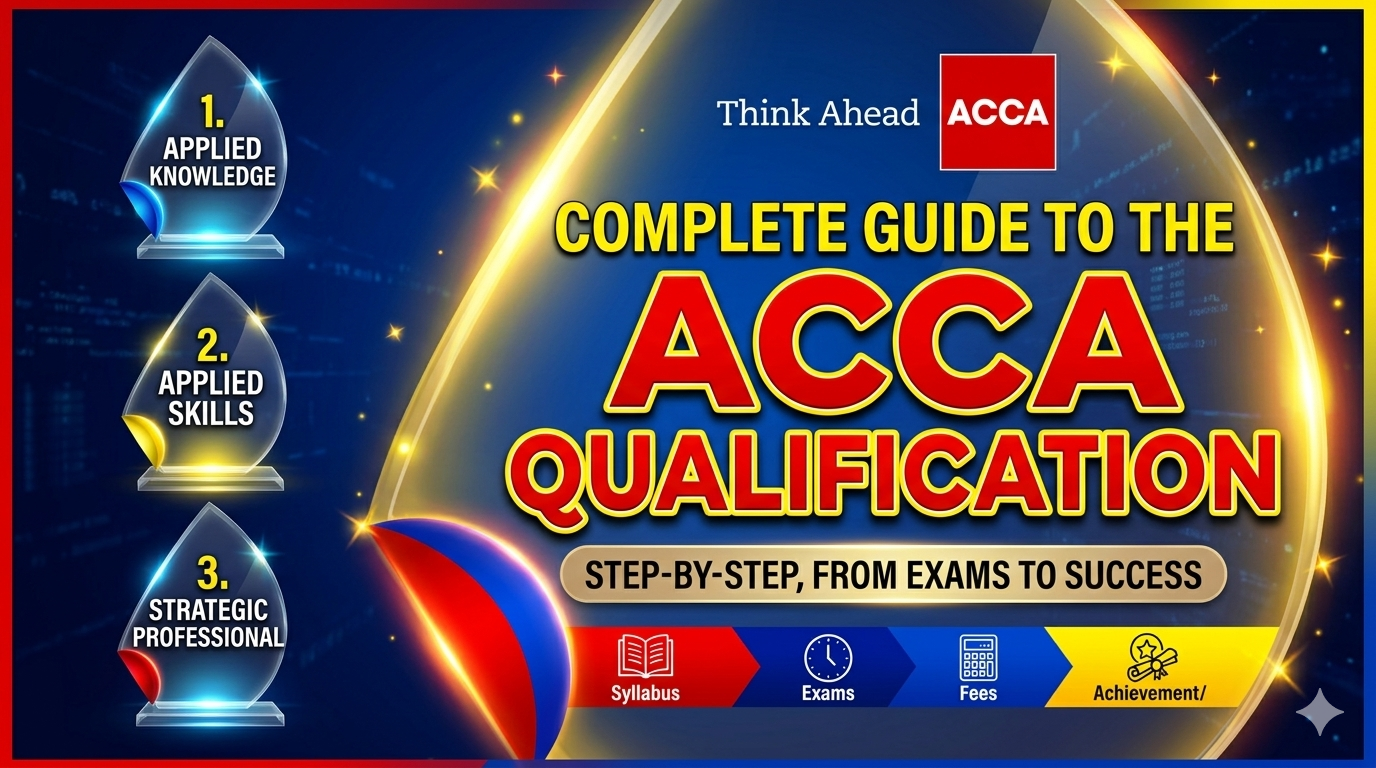
Structure, Requirements, Fees, Exams & Career Prospects (2026 Update)
The Association of Chartered Certified Accountants (ACCA) is one of the world’s most prestigious and globally recognised professional accountancy qualifications. With members in over 180 countries, ACCA equips you with the technical expertise, ethical standards, and strategic skills needed to thrive in finance, accounting, auditing, taxation, and business leadership roles. Whether you’re a recent high-school graduate, a commerce student, or a working professional seeking career advancement, the ACCA pathway offers flexibility, exemptions, and international mobility.
In this comprehensive blog, we break down everything you need to know: registration requirements, fees, exam sessions, the detailed structure of each level, and the exciting career prospects once you qualify as an ACCA Affiliate or full Member.
- Requirements to Register for ACCA
ACCA is designed to be accessible. The minimum entry requirement is broadly equivalent to:
- Two A-Levels (or equivalent) + three GCSEs (or equivalent) in five separate subjects, including English and Mathematics.
Country-specific notes (e.g., Bangladesh): Higher Secondary Certificate (HSC) or equivalent secondary education usually qualifies you for direct entry, provided you have strong passes in English and Mathematics. A Bachelor’s degree (even a 2-year one) is often sufficient. If your qualifications fall short, you can start with the Foundations in Accountancy (FIA) route and later progress to the full ACCA Qualification.
Key steps to register:
- Create an account on the official ACCA website (accaglobal.com).
- Submit your academic documents for eligibility and exemption assessment (if you have a degree or prior qualifications).
- Pay the one-time registration fee.
- No upper age limit — many students join after 12th grade or while working.
Exemptions: Graduates in commerce, accounting, or business may skip several papers (Applied Knowledge and some Applied Skills). ACCA assesses this via their online exemption calculator during registration.
- ACCA Fees (2026)
All fees are in GBP and paid online via your myACCA portal. Here is the latest official structure:
|
Fee Type |
Amount (GBP) | Details |
| Initial Registration | £89 | One-time fee when you first join |
| Annual Subscription | £140 | Due every year (by 1 January) to stay active |
| Ethics & Professional Skills Module | £81 | Mandatory module |
| Applied Skills exams | £155 per exam | Standard entry (June 2026 example) |
| Strategic Business Leader (SBL) | £274 | Essential paper |
| Strategic Business Reporting (SBR) | £202 | Essential paper |
| Strategic Professional Options (AFM, AAA, ATX, APM) | £202 each |
Choose any 2 |
| Exemption fee (per paper) | £86 (Knowledge) / £114 (Skills) | If you claim exemptions |
Notes on Applied Knowledge exams: These are on-demand computer-based exams (CBE). Fees are typically lower (often £90–£120 range) and set by approved CBE centres or for remote sitting — check your local centre or myACCA for exact pricing.
Additional costs may include study materials, tuition (optional), and local centre fees. Late entries are limited or unavailable in some sessions, so book early to save money.
- Exam Sessions & Format
ACCA offers four exam sessions per year:
- March (2–6 March 2026)
- June (1–5 June 2026)
- September (7–11 September 2026)
- December (dates to be confirmed)
Important details:
- Applied Knowledge (BT, MA, FA): Available on-demand as computer-based exams — sit them anytime at an approved centre or remotely (subject to availability).
- Applied Skills & Strategic Professional: Session-based CBEs held during the four windows above. March and September have limited variants; June and December offer the full range.
- Standard entry deadlines apply (e.g., 16 April 2026 for June session). Late entry is restricted or unavailable in some sessions.
- Results are released about 5–6 weeks after each session.
You can sit up to four exams per session (subject to rules), giving you excellent flexibility.
- Detailed Levels & Papers in the ACCA Qualification
The ACCA Qualification has three progressive levels (total 13 exams) plus two mandatory non-exam elements.
Applied Knowledge (3 papers) – Foundation stage Builds core understanding of finance and accounting.
- BT: Business and Technology
- MA: Management Accounting
- FA: Financial Accounting
Applied Skills (6 papers) – Intermediate stage Develops practical, technical skills for real-world application.
- LW: Corporate and Business Law
- PM: Performance Management
- TX: Taxation
- FR: Financial Reporting
- AA: Audit and Assurance
- FM: Financial Management
Strategic Professional (4 papers) – Advanced stage Prepares you for leadership roles.
- Essentials (both mandatory):
- SBL: Strategic Business Leader
- SBR: Strategic Business Reporting
- Options (choose any 2):
- AFM: Advanced Financial Management
- AAA: Advanced Audit and Assurance
- ATX: Advanced Taxation
- APM: Advanced Performance Management
Plus two essential modules:
- Ethics and Professional Skills Module (EPSM) – Completed early (ideally before Strategic Professional).
- Practical Experience Requirement (PER) – 36 months of relevant, supervised work experience + 9 performance objectives.
Once you complete all 13 exams + EPSM, you become an ACCA Affiliate. Full ACCA Member status is awarded after fulfilling the PER.
- Career Prospects After Qualifying as an ACCA Affiliate & Member
ACCA Affiliate (exams + EPSM complete): You can immediately start working in mid-level finance roles. Employers value your technical knowledge, and you can use the designation “ACCA Affiliate”. Many graduates land jobs in accounting firms, banks, MNCs, or corporate finance teams right after becoming an affiliate.
ACCA Member (Affiliate + 36 months PER): This is the gold standard. You earn the right to use the prestigious “ACCA” letters after your name, gain full global recognition, voting rights within ACCA, and access to exclusive member benefits.
Typical career paths & prospects:
- Entry to mid-level (Affiliate): Accountant, Tax Assistant, Auditor, Financial Analyst, Management Accountant (salary boost of 30–50% vs non-qualified roles).
- Senior & leadership (Member): Finance Manager, CFO, Audit Partner, Tax Consultant, Business Advisor, Financial Controller. Many members reach six-figure salaries in multinationals.
- Global opportunities: Work anywhere in the world — Big 4 firms (PwC, Deloitte, EY, KPMG), banks, consulting, government, or your own practice (audit signing rights in many countries).
- In Bangladesh & South Asia: High demand in banking (e.g., HSBC, Standard Chartered), manufacturing, NGOs, and audit firms. ACCA Members often secure faster promotions and international assignments.
Studies consistently show ACCA-qualified professionals earn significantly higher salaries and enjoy faster career progression than non-qualified accountants. The qualification also opens doors to further credentials like CFA, CPA, or CIMA.
Final Thoughts
The ACCA journey is challenging but incredibly rewarding. With flexible on-demand exams, generous exemptions, and a truly global qualification, it’s one of the best investments you can make in your future. Start today by checking your eligibility on the official ACCA website and registering — the earlier you begin, the sooner you’ll reap the rewards.
Ready to take the first step? Visit accaglobal.com and use their exemption calculator.
If you have questions about exemptions, study plans, or how ACCA fits your background (especially in Bangladesh), feel free to drop a comment or reach out — happy to help!
All fees and dates are as per official ACCA information for 2026 and subject to change. Always verify the latest details on the ACCA website.
